
McKinney Busted Mugshots and Records
McKinney is the Collin County seat. Police, sheriff, jail, and court offices all share one city. That does not make them one records custodian. The McKinney Police Department builds its own incident records. The Collin County Sheriff's Office runs the detention facility and its custody tools. Someone arrested by city police can show up later in a county search. Even then, the county entry does not replace the original police report.
The 2020 Census put McKinney at 195,308 residents. Treat that figure as context, not a booking count or roster. A city record request may still be needed when a person sits in county custody, since the jail photo may belong to CCSO rather than city police.
Where McKinney Busted Mugshots Appear
McKinney has no complete daily mugshot gallery for public search. The city publishes records-request information and annual workload statistics instead. On the county side, custody covers anyone transferred to the detention facility. Photos sometimes appear in the judicial search too. Neither the roster nor the recent-event report promises an image for every entry. That gap is a real limit. It is not a search trick you have yet to find.
| Channel | Official? | What it covers | Use it for |
|---|---|---|---|
| McKinney Records and Reports | Yes | City request routes and report information | A city-created police record |
| McKinney Records and Permits | Yes | Additional city records-request access | Choosing a request channel |
| CCSO Inmate Information | Yes | Current county custody and releases within 24 hours | A detention transfer or very recent release |
| SOSTORE Arrests & Releases | Yes | One to seven prior days of county arrest and release events | A recent event outside the 24-hour display |
| BustedNewspaper, RecentlyBooked, and Texas Arrests | No | Vendor entries that may label McKinney Police | A lead that requires official verification |
Vendor websites can seem to stretch back far past the county's one-week event window. That range reflects the publisher's retention choice, nothing more. It is not proof of a complete county record. Entries there can be dated, duplicated, incomplete, or simply wrong, so never treat them as evidence of current custody or of how a McKinney case ended.
Busted in McKinney: Find Custody
Want to know whether a McKinney arrest reached Collin County detention? Work the county's two official windows in order. Each covers a different span of time. Neither one replaces an MPD request for an incident report. The Collin County record search explains custody, booking photos, feeds, and the county request process in more depth.
- Open CCSO Inmate Information and use the linked JudicialOnlineSearch2 interface for current custody or release within the preceding 24 hours.
- If a name is not in that window, create a SOSTORE Arrests & Releases report for a narrow prior day and expand to seven days when the date is uncertain.
- Use Collin County case information to check whether the result connects to bond, a case, active warrant information, time served, or a mugshot where the county makes one available.
- Send a request to McKinney Police when the needed item is the city report, and to CCSO when the needed item is an existing county booking record or photo.
The live inmate tool has no published refresh schedule. A person no longer listed may have been released. Or transferred, moved elsewhere, or simply outside the display rule. For a recent county event, SOSTORE is the next official check. It works as a rolling report, not a permanent archive. A booking photo belongs to the county custody or judicial record. Otherwise it must come from the right custodian.
Shared names call for care. The county says its official search links current inmates with mugshots where available, bond, time served, active warrants, and criminal cases. A name match is only a starting point. Compare agency, dates, case details, and any other identifiers before calling it a match, since results change over time.
Note: City arrest, county custody, and court case are separate stages, so request from the agency that matches the stage.
McKinney Police Booking Requests
McKinney accepts records requests several ways. In person, by email, fax, mail, and online all work. The city's Records and Reports page and Records and Permits page lay out each route. Help the records unit find the file. Give a name, date, location, incident or report number, and the specific record you want. No fixed booking-photo fee or promised turnaround is published. Ask for a current estimate when an image or a lengthy record is involved.
2200 Taylor Burk Drive
McKinney, TX 75071
Records: (972) 547-2820
Fax: (972) 547-2792
Lobby: Monday through Friday, 8:00 a.m. to 5:00 p.m.
Published examples show a routine public report at no charge. An accident report runs $6. A certified version costs $8. Open-record fees can shift with the request, so treat those numbers as examples. None of them sets a price for a booking photo. If the intake photo you want sits with the county rather than MPD, send the request to CCSO Open Records. The Sheriff's office custodians the county jail.
Requests go smoothest when they name a record that exists. Describe the city event too. Asking for every record tied to a name can trigger clarification delays or unpredictable costs. The distinction matters in McKinney, where a county office may sit blocks away while the police report still belongs to MPD. A court outcome is a separate record, held through the county clerk or court system.
McKinney Busted Data Is Annual
McKinney's transparency effort shows up once a year. There is no day-by-day log. The 2024 report counts 2,353 arrest reports, 9,786 incident reports, and 1,938 accident reports. Add 3,657 open-records requests and 1,192 interagency requests. Together they give a real sense of the department's workload. What you do not get is a searchable daily feed. No individual arrest can be pulled from these totals. Nothing in them promises that a booking image is public, either.
| 2024 McKinney Police measure | Reported total |
|---|---|
| Arrest reports | 2,353 |
| Open-records requests | 3,657 |
| Interagency requests | 1,192 |
| Incident reports | 9,786 |
| Accident reports | 1,938 |
The matching McKinney Records and Reports page screenshot shows the request route that pairs with the annual report.
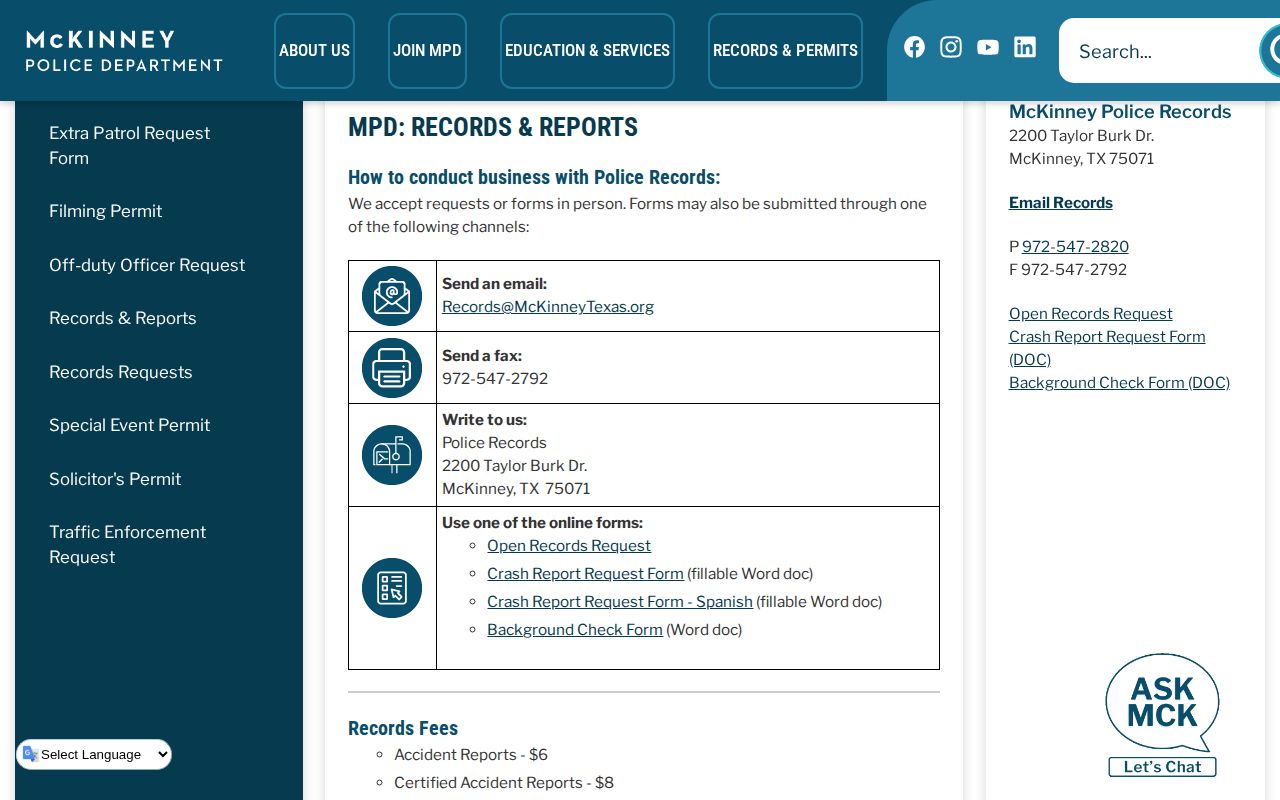
The lesson in these numbers is simple. Workload reporting and individual records are different things. So if you need a specific McKinney booking answer, you still have to make a focused request or use the county custody tools.
McKinney Arrest Stories Need Records
Dallas Express, Dallas Morning News, FOX 4, NBC 5, and Community Impact each pick which McKinney cases to cover. Community Impact keeps a section for city and county news. Regional outlets may report on events that start with city police or county detention. That coverage is not an official daily feed, and it may leave out the booking photo. Treat it as context rather than a substitute for the police report, jail status, or court file.
For the wider picture, Collin County crime news pulls the media landscape together. Whatever the story, trace it back to the official agency or case system. A published bond amount only shows that a release condition existed. The later docket, when you can reach it, tells you the case result.
McKinney and Frisco Release Difference
Frisco offers a contrast worth noticing. Within Collin County, it publishes selected police media releases and arrest-report PDFs. Those can carry event details, bond information, and county-jail custody language. McKinney takes a different documented path. It leans on Records and Reports, Records and Permits, and annual workload figures instead of any daily searchable mugshot log. The gap matters. A reader who assumes every city records page works like a Frisco release will come away confused.
Once someone lands in the Collin County Detention Facility, both cities depend on the same county custody tools. A city document describes an initial event. The county roster and the SOSTORE report reflect later custody status within their limited windows. The original report must still be requested from the police department that wrote it. Agency origin beats city name every time in a search.
McKinney Busted Records Have Custodians
McKinney is the county seat, so county offices can feel like city offices. The custodian, however, still depends on the record itself. McKinney Police holds the city report. CCSO holds the sheriff and detention record. The District Clerk, County Clerk, and justice courts each serve different case types. Asking the right office keeps an arresting agency's report, a jail booking entry, and a judicial outcome from blurring together.
For a city arrestee who reached the Collin County Detention Facility, the current inmate interface shows present county custody plus anyone released within 24 hours. SOSTORE reaches back one to seven days, which helps explain a recent release or a name that vanished from the roster. Neither source promises a photo. And absence from both proves nothing about whether a McKinney arrest happened.
Texas Department of Criminal Justice plays yet another role. Its offender search tracks sentenced state-prison status, not McKinney booking photos, and the agency's public information states plainly that photographs are not provided through its email process. Federal and immigration systems run on separate custody paths too. Someone out of county detention may simply have moved between systems, and no missing photo or vendor listing can tell you that.
Location can mislead here. The record's source still decides the route. A city-created report may describe an event inside McKinney even when no county intake followed, while a county booking file stays relevant after a city arrest moves into detention. The court file then reflects the legal case built on those earlier stages. Keeping the three separate stops a city search from being oversold as a full detention or disposition search. The Collin County Sheriff's Office runs the Detention Facility from its McKinney address, and its custody record, the police report, and the court file remain distinct sources throughout.